

Prison PUP Program
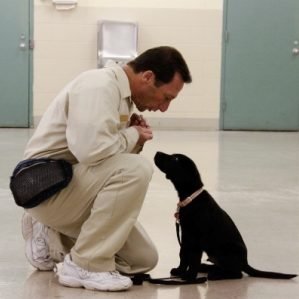
Prison PUP Program
Many enter our Prison PUP Program directly at 8 to 9 weeks of age to begin their training. Other Service Dogs in Training enter the Prison PUP Program after spending time with a volunteer Full-Time Puppy Raiser. No matter which route a dog follows, it lives with an incarcerated individual handler in prison Monday through Friday. Volunteer Weekend Puppy Raisers take the puppies out of prison each weekend to work on house manners, socialization, and maintaining the skills taught in prison.
About the Incarcerated Individuals Handling Dogs in the Program
Each incarcerated individual that applies to be a puppy trainer must meet certain criteria in behavioral history and must make a 12-18 month commitment. A prison liaison selects appropriate handlers, and then a NEADS trainer conducts additional interviews to ensure that they are right for our program. The men and women who are selected are usually described as model incarcerated individuals with exceptional records. NEADS maintains consistent, ongoing communication with correctional officers, inmates, and prison administrators at all times. The influence of the Prison PUP Program on the men and women in prison is tremendous. Even the officers and inmates who do not participate in the program report that the presence of NEADS Dogs changes the atmosphere for everyone.
Prison Life
Each puppy lives with a primary handler. A backup handler is also assigned to each puppy to provide additional support. Puppies spend most of their time with the primary handler going to classes, recreation areas, and dining halls. Each puppy sleeps in his or her primary handler’s dormitory-like room.
NEADS trainers make regular visits to each participating prison to conduct classes for the incarcerated individuals in the program. In class, they learn how to teach the Service Dog in Training tasks and exceptional obedience skills. In addition, they learn how to groom and properly care for the dog, provide basic first aid, and monitor canine health. The NEADS trainers assess each puppy to make training recommendations and assign homework for the handler.
Incarcerated individuals provide the puppies with socialization by bringing the dogs with them whenever possible. Whether going to a medical appointment, the TV lounge, or the family and friends visiting room, the handler usually has the puppy right by his or her side.
Weekends with Raisers
To ensure that the puppies have a full range of experiences, volunteers help out by socializing the puppies on weekends. These Weekend Puppy Raisers, specially trained in socialization skills by NEADS, are assigned to a puppy for the entire time the dog is in the prison program. Puppies spend their weekends at a volunteer’s home and follow the volunteer’s routine around town. This way, the puppies become accustomed to things like car rides, traffic, bus stations, movie theaters, restaurants, grocery stores, and all the typical experiences of life.
Our Prison PUP Program Partnerships
NEADS began the Prison PUP Program in 1998 at North Central Correctional Institution in Gardner, Massachusetts. NEADS currently has partnerships with prisons in Massachusetts and Rhode Island. There are usually six to eight (and as many as 12) puppies in every facility. Each prison administration decides how many dogs it can house and raise comfortably. Most facilities designate a section of housing for the program where handlers are given single rooms to accommodate the inmate and puppy. Our current Prison PUP Program partnerships (subject to change) include:
- JJ Moran Medium, Cranston, RI
- MCI Norfolk, Norfolk, MA
- North Central Correctional Institution, Gardner, MA
- Northeastern Correctional Center, Concord, MA
- MCI Framingham, Framingham, MA
Celebrating more than 20 years of our Prison PUP Program
In 1998, NEADS began its Prison PUP Program (PPP) at NCCI in Gardner, MA. Today, NEADS is in 4 prisons in Massachusetts and 1 in Rhode Island.